

The Real Facts Behind Licenced Weight Loss Jabs: part 1
Scary stories sell newspapers and success stories sell products but when you’re looking for a safe way to lose weight what can you believe? Personally, I will say that I believe licensed weight loss jabs have the potential to make the biggest contribution to medicine and preventable health since Penicillin.
But this is not about my opinion it’s about the facts, explaining in plain English how medicines get licensed, the mechanisms these jabs target and the pro’s and cons of using them.
Firstly let’s just get REALLY clear what a licensed drug is…
Before a medicine is allowed into your body, it must first survive years of scrutiny.
Long before a weight-loss injection (or any licensed drug) reaches a clinic or pharmacy, it begins its life in a laboratory. Scientists test it on cells and in animals to see how it behaves and whether it shows any obvious signs of harm. (Most compounds fail at this very early stage).
Only if it looks reasonably safe does it move on to human trials.
- First, it’s given to small numbers of healthy volunteers to answer one simple question: can the body tolerate it?
- Next, it is tested in people with the condition it is meant to treat, to see whether it actually works and what dose makes sense.
- Finally, it is trialled in thousands of people and compared against either a placebo or existing treatments, tracking not just results but side effects and long-term risks.
This process can take five to ten years.
When all of that data is collected, it is sent to independent regulators. In the UK, this is the MHRA. Their job is not to be impressed by promises, but to interrogate the evidence:
- How reliable were the trials,
- How common were side effects,
- How strong were the benefits,
- How consistently the drug can be manufactured.
Only if the benefits clearly outweigh the risks is the medicine licensed for use.
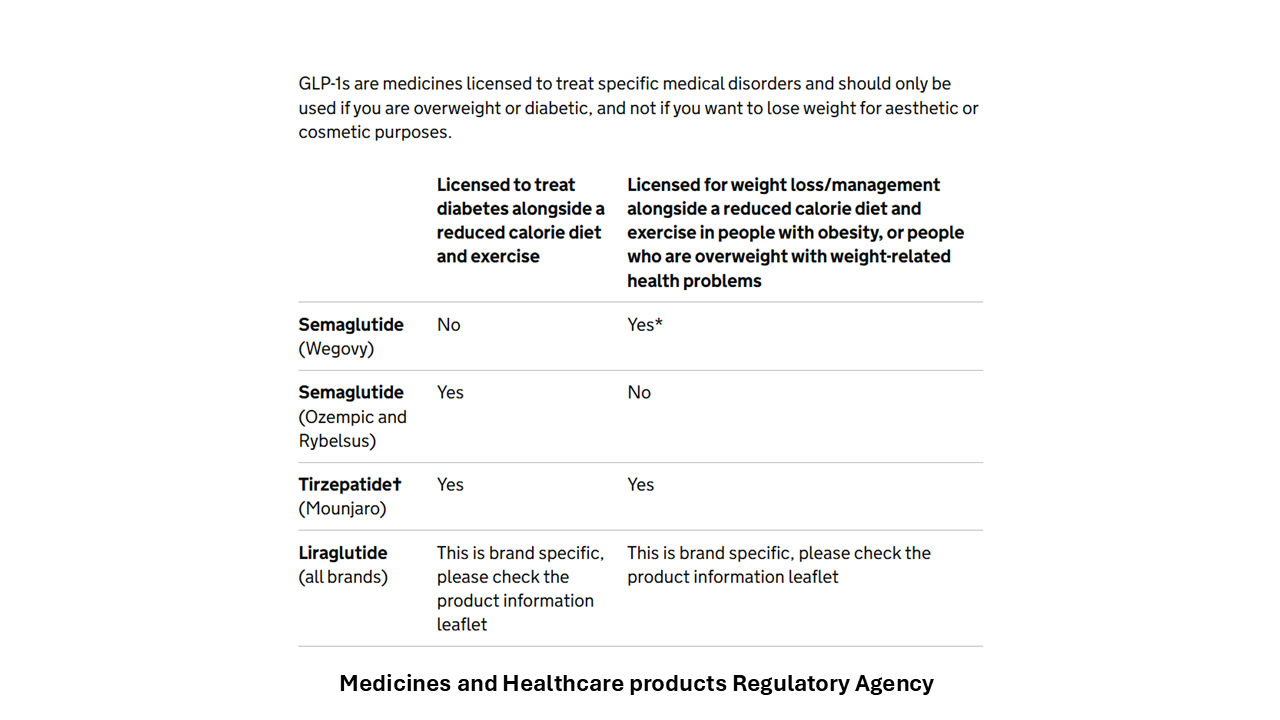
And even then, the story does not end there.
Once a medicine is in real-world use, every side effect is monitored through national reporting systems. Guidance can change. Warnings can be added and, in rare cases, medicines are withdrawn altogether. Licensing is not a one-off decision; it is an ongoing responsibility.
This is why a “licensed medicine” is very different from something trending on social media.
It does not mean the drug is perfect or risk-free. It does not mean it works for everyone. But it does mean it has been tested properly, independently, and transparently.
In a world full of hyped up health claims, that matters.
Because real progress in health does not come from hype, likes or shares. It comes from evidence, patience, and accountability.
Mechanisms
Not all weight-loss injections work in the same way.
Although they’re often grouped together as “the jabs”, there are two distinct types:
- Single-mechanism medicines
- Dual-mechanism medicines
The difference lies in the hormones they mimic inside the body.
And this is where things get interesting — because the hormones these medicines mimic don’t just influence appetite. They shape blood sugar, cravings, metabolic flexibility, and even long‑term sustainability.
make sure you don’t miss Part 2 ‘Weight-loss jabs aren’t magic. They’re rooted in real biology’ Where I explain what these mechanisms actually mean inside a real human body — and why some people thrive on these medicines while others struggle