

Dairy vs Meat: They are not interchangeable
People often talk about “saturated fat” as though butter, yoghurt, cheese and steak all behave the same….They don’t.
Dairy fat
Fermented dairy — like yoghurt and cheese — consistently shows neutral or even protective associations in cardiovascular research.
Why?
Because dairy arrives in a complex food matrix:
- Calcium binds some fatty acids in the gut
- Fermentation alters lipid metabolism
- Protein slows absorption
- It influences satiety hormones
And this is where we need to be real for a moment.
Butter behaves differently from cheese. Cheese behaves differently from cream. They’re all “dairy fats,” but they don’t land in the body the same way.
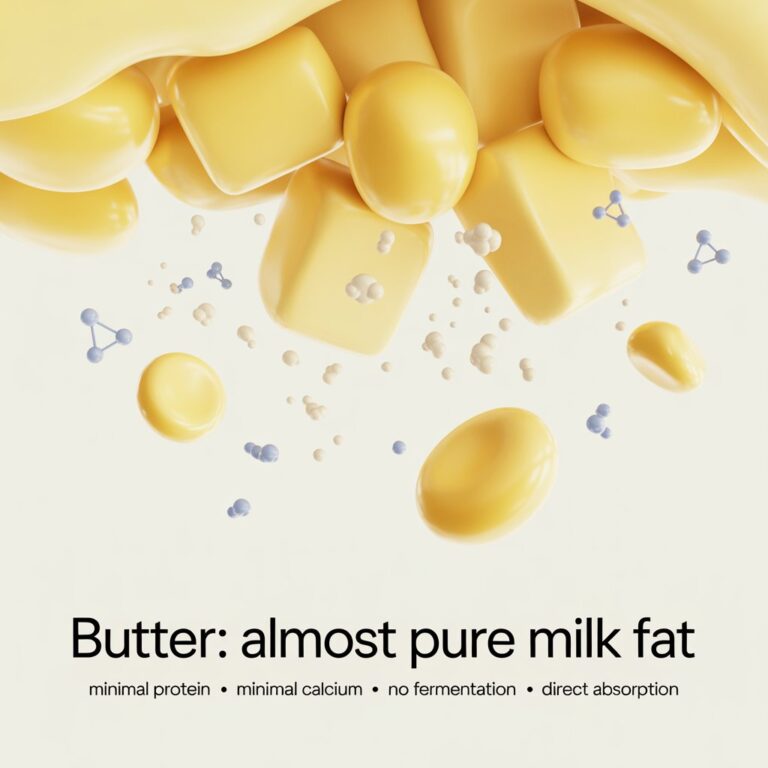
Butter is almost pure milk fat: minimal protein, minimal calcium, no fermentation, no structural matrix. It is absorbed more directly and, in controlled trials, has a clearer LDL-C raising effect – to read more about what LDLs are: click here
That does not make butter a toxin. It makes it a concentrated fat source.
Cheese, on the other hand, brings protein, minerals, fermentation, and a solid matrix that slows digestion and changes how those fats are handled. The same grams of saturated fat behave differently because the package is different. Personally I can literally eat cheese till the cows come home, but give me butter and it’s not long before I’m creasing up.
You may have even noticed for yourself that you or someone you know tolerates one food but not another that to the uninitiated may seem to contain the same ingredients. And this isn’t just preference or ‘odd’, it’s likely to be the difference in food matrix and individualised metabolic responses.
Meat fat
Scientific studies of unprocessed red meat consumed in moderate portions does not consistently show strong links with cardiovascular disease in metabolically healthy populations. And when we say moderate, we’re talking about the kind of portions most people already recognise as reasonable, roughly a palm‑sized serving (80–120g cooked), a few times per week, not half a kilo every night.
But processed meats do. And that’s the pivot point.
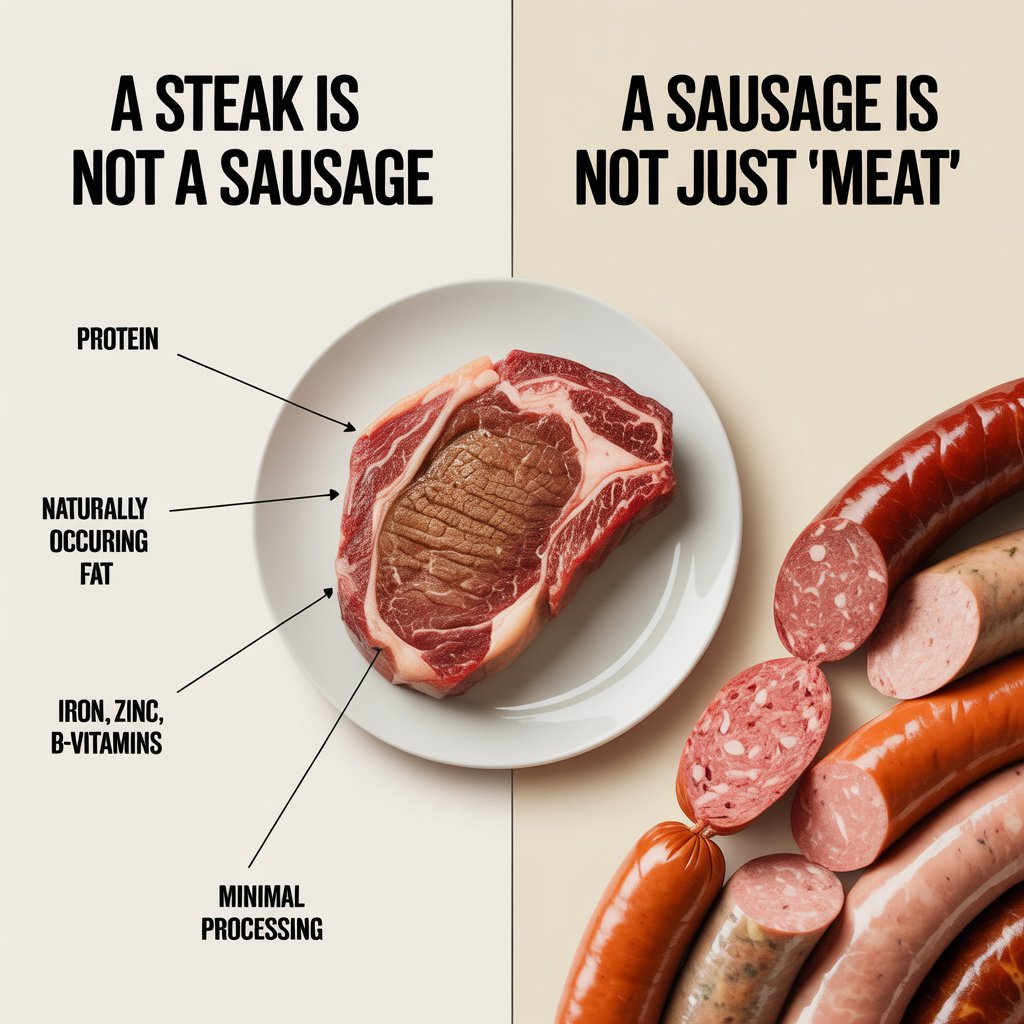
A Steak Is Not a Sausage
And a Sausage Is Not Just “Meat”
A steak is intact muscle tissue providing:
- Protein
- Naturally occurring fat
- Iron, zinc, B-vitamins
- Minimal processing
A sausage, even from a butcher, is:
- Minced meat
- Often higher in fat proportion
- Salt added
- Sometimes preservatives
- Often easier to overeat
And a mass-produced sausage?
- Mechanically processed meat
- Higher sodium
- Emulsifiers
- Stabilising agents
- Standardised fat ratios
Same broad category: “animal fat” very different metabolic experience.
And then there’s the sausage roll:
- Refined carbohydrate spike
- Easier overconsumption
- Higher total energy density
- Often poorer fat quality
The issue is not just saturated fat. It’s saturated fat combined with refined carbohydrate and processing.
That combination is far more disruptive to metabolic health.
Home-Made vs Mass-Made
Now let’s get even more real.
A homemade steak and chips cooked in olive oil, eaten with vegetables, is not metabolically equivalent to:
A mass-produced ready meal containing processed meat, refined starch, stabilisers and flavour enhancers.
Industrial processing changes:
- Portion size
- Energy density
- Palatability
- Eating speed
- Hormonal response
Depending on the product/processing, industrial scale processing may also substantially increase sodium, introduce nitrates/nitrites and increase oxidation during curing and high-heat processing.
And as we all know…when food becomes hyper-palatable it’s easy to overconsume and total energy intake rises almost invisibly.
That’s where saturated fat becomes a passenger in a much bigger metabolic problem.
And again despite the hype processed foods are not toxins, however processed meats are consistently associated with increased cardiovascular and colorectal cancer risk in large cohort studies (e.g. Micha et al., Circulation 2010; IARC 2015 classification).
That risk signal is far weaker for unprocessed red meat.
So the harm signal appears linked to processing, not simply animal fat content.
When Should You Pay Closer Attention?
Be more cautious if you have:
- Raised ApoB
- Insulin resistance
- Fatty liver
- Strong family history of early heart disease
In that context, saturated fat may push LDL particle production higher.
But even then, the first lever is usually: Improve metabolic health. Increase fibre. Reduce ultra-processed foods. Address overall energy balance.
Not panic-eliminate eggs.
The Bottom Line
Saturated fat is not a toxin.
It’s context dependent.
Dairy is not the same as red meat. Red meat is not the same as processed meat. A steak is not a sausage roll. And homemade food is not industrial food.
If you want a simple rule:
Focus on food structure, metabolic health and processing level — not fear-based media headlines. That’s how you move from confusion to clarity.
Because Real Nutrition Matters.
Niki Kerr is a qualified nutritionist, an award-winning writer and behaviour-change specialist. Bringing a thought-leader lens to Food, Nutrition and modern weight loss (including GLP-1 medications) with an evidenced focus on what actually works in real life: nourishment, consistency, and behaviour change that sticks.
Key References
- Total saturated fat and cardiovascular risk (not harmful in isolation) Siri-Tarino et al., 2010, American Journal of Clinical Nutrition
- Fermented dairy and heart health Dehghan et al., 2018, The Lancet(PURE study)
- Cheese vs butter (dairy matrix effect) Hjerpsted et al., 2011, American Journal of Clinical Nutrition
- Processed vs unprocessed meat and CHD risk Micha et al., 2010, Circulation
- Ultra-processed food and passive overconsumption Hall et al., 2019
- ApoB as a stronger risk marker than LDL-C Sniderman et al., 2019